
Yono Rummy Strategy Tips for Beginners
Playing the Yono Rummy game involves more than simply picking cards and discarding the ones you do not need. Beginners must learn how to recognise useful combinations, organise their hands and make decisions based on the cards they hold.
A good Yono Rummy strategy starts with understanding which cards are worth keeping, when to discard an unwanted card and how to use jokers without losing sight of the required combinations.
If you are new to rummy, the right approach can help you understand the game more clearly and avoid common mistakes. This guide covers practical Yono Rummy tips for beginners, with simple examples based on standard 13-card Indian rummy.
These strategies can help you make more informed decisions, but they cannot guarantee a win. The outcome of a game also depends on the cards dealt, other players’ decisions and the rules of the selected format.
1. Prioritise Your Pure Sequence
One of the most important Yono Rummy strategy tips for beginners is to focus on forming a pure sequence early.
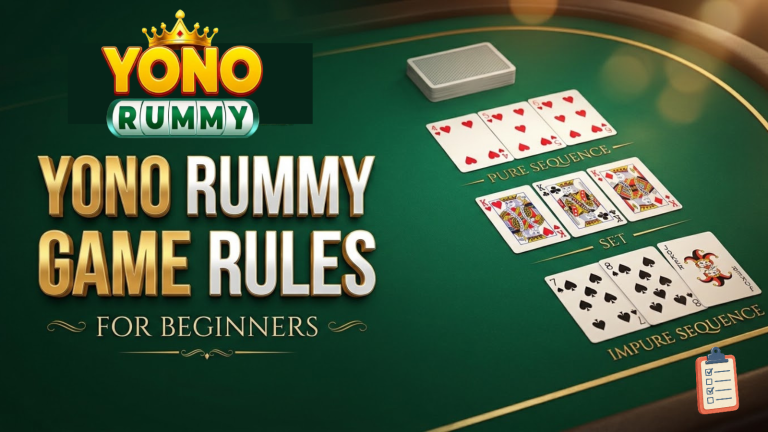
A pure sequence consists of at least three consecutive cards from the same suit without using a joker as a substitute.
For example:
- 4♥, 5♥, 6♥
- 7♠, 8♠, 9♠
- J♦, Q♦, K♦
In standard 13-card Indian rummy, a valid declaration generally requires at least two sequences, including one pure sequence.
This makes a pure sequence an important part of your hand.
Beginner tip: When reviewing your initial cards, identify possible pure sequences first. Then consider how the remaining cards can form other valid combinations.
Do not rely entirely on jokers to complete your hand, as they cannot replace a missing card in a pure sequence.
2. Arrange Your Cards by Suit and Rank
Keeping your cards organised can make it easier to identify potential combinations.
Instead of looking at all 13 cards randomly, arrange them by suit and rank.
For example, consider this hand:
- 3♥, 4♥, 6♥
- 7♠, 8♠, 9♠
- 5♦, 5♣, 5♠
- J♣, Q♣
- 2♦, K♥
The cards can be organised into groups based on their suits and ranks. You may notice that:
- 7♠, 8♠, 9♠ form a pure sequence.
- 5♦, 5♣, 5♠ form a set.
- J♣, Q♣ may become a sequence if you obtain 10♣ or K♣.
- 3♥, 4♥, 6♥ could become a sequence if you obtain 5♥.
Organising your cards helps you recognise which combinations are already complete and which need one more card.
3. Keep Flexible Card Combinations
A useful Yono Rummy tip is to keep cards that can contribute to more than one possible combination.
For example, if you have 5♠, 6♠ and 7♠, you already have a sequence.
However, if you hold 5♠, 6♠ and 8♠, you may be waiting for 7♠ to complete the sequence.
The cards you keep should support your existing combinations or create reasonable opportunities for new ones.
Example: An open-ended sequence
Suppose you have:
8♥, 9♥
You may be able to complete the sequence by drawing either 7♥ or 10♥.
This gives you more possible ways to complete the combination than holding a pair that depends on only one specific card.
However, do not keep every possible combination indefinitely. Your decisions should also account for the cards you need to discard and the progress of the game.
4. Discard High-Value Cards When They Are Not Useful
In standard points rummy, high-value cards can contribute more points to an uncompleted hand.
For example, cards such as K, Q and J generally carry higher point values than low-numbered cards.
If you are holding unrelated high-value cards that are not helping you form a sequence or set, keeping them for too long may increase your potential penalty.
Consider this example:
You have:
- K♥
- Q♣
- J♦
These cards are not a valid sequence because they belong to different suits.
If they do not support other combinations, keeping them may be less useful than discarding them.
However, avoid discarding a high-value card automatically. A card that appears unrelated may still contribute to a useful combination later.
The best decision depends on your current hand and the rules of the selected rummy format.
5. Use Jokers to Complete Impure Sequences and Sets
Jokers are useful because they can substitute for missing cards in eligible combinations.
For example, if you have:
- 6♣
- 7♣
- Joker
The joker may represent 8♣ and complete an impure sequence, provided the game rules permit it.
Jokers may also help complete eligible sets.
A practical joker strategy
Consider the following:
- Use a joker where it helps complete an important combination.
- Avoid using a joker in a pure sequence.
- Do not assume that every joker must be used immediately.
- Check whether the joker can help complete a more useful combination elsewhere in your hand.
A joker can provide flexibility, but its value depends on how you use it.
6. Pay Attention to the Discard Pile
The discard pile can provide useful information about the cards other players may need.
For example, if another player picks up 9♥ from the discard pile, they may be trying to complete a sequence or set involving that card.
This does not tell you their entire hand, but it can offer a clue about their possible combinations.
Similarly, cards that have already been discarded may be less likely to become available again, depending on the game’s rules and the remaining cards.
How beginners can use this information
- Notice which cards other players pick up.
- Observe which cards they discard.
- Avoid assuming that every discarded card is useless to everyone.
- Use visible information as one factor when deciding what to discard.
Remember that these observations are only clues. You cannot know another player’s complete hand from their discards alone.
7. Avoid Breaking Completed Combinations Without a Reason
Once you have formed a useful sequence or set, think carefully before breaking it apart.
For example:
3♦, 4♦, 5♦
This is already a pure sequence.
Discarding one of these cards may leave you with an incomplete combination and could make it harder to complete your hand.
However, keeping a completed combination is not always the best decision. If another arrangement creates a better opportunity to complete your hand, you may need to reconsider it.
The key is to evaluate the entire hand rather than making decisions based on one combination alone.
8. Understand the Rummy Format Before Playing
Not every rummy game follows the same scoring or end-of-game rules.
Yono Rummy is described in the project reference as a multi-game platform with rummy as its primary focus. The exact rummy formats currently available should be verified before publication.
Different rummy formats may use different rules.
| Rummy Format | What Beginners Should Understand |
|---|---|
| Points Rummy | Learn how points are calculated and how the winner is determined. |
| Pool Rummy | Understand the pool limit and how players are eliminated. |
| Deals Rummy | Learn how scores are carried across multiple deals. |
These are general descriptions of common Indian rummy formats. Check the selected game’s instructions for its actual rules.
Understanding the format helps you make decisions that are appropriate for the game you are playing.
9. Avoid Rushing Your Decisions
Beginners sometimes discard cards too quickly without checking whether they can form a useful combination.
Before discarding, ask yourself:
- Does this card help complete a sequence?
- Can it form a set with other cards?
- Is it useful with a joker?
- Am I breaking a combination that is already complete?
- Is there another card that would be less useful to keep?
Taking a moment to review your hand can help you avoid unnecessary mistakes.
This does not mean that every turn needs to be complicated. With practice, recognising useful combinations becomes easier.
10. Practise Without Treating Rummy as an Income Source
The best way to learn the basic Yono Rummy strategy is to understand the rules and practise making decisions.
Beginners can focus on:
- Identifying pure and impure sequences.
- Recognising valid sets.
- Understanding how jokers work.
- Organising cards by suit and rank.
- Reviewing possible discards.
- Learning the scoring system of the selected format.
If the game involves real money, remember that rummy carries financial risk. A strategy cannot guarantee winnings, and the game should not be treated as a reliable source of income.
Set a spending limit before playing, avoid chasing losses and stop if the game is no longer enjoyable.
A Simple Yono Rummy Strategy Example
Let’s consider a hypothetical 13-card hand:
| Cards | Possible Combination |
|---|---|
| 4♥, 5♥, 6♥ | Pure sequence |
| 8♠, 9♠, 10♠ | Pure sequence |
| 7♦, 7♣, 7♥ | Set |
| J♣, Q♣ | Potential sequence |
| 2♦, K♠ | Unconnected cards |
In this example, the player has two pure sequences and one set.
The remaining cards include a possible sequence and two unconnected cards.
A beginner might consider the following:
- Keep the completed pure sequences.
- Retain the set if it supports the hand.
- Consider whether J♣ and Q♣ can be completed with 10♣ or K♣.
- Review 2♦ and K♠ to determine whether they are useful.
- Discard cards that are not contributing to a valid combination or a reasonable plan.
This example illustrates how a player can evaluate their hand. It does not guarantee that the player will complete a valid declaration.
Common Yono Rummy Strategy Mistakes
Even when beginners understand the rules, they may make mistakes while playing.
Keeping too many high-value cards
Unconnected high-value cards may increase your potential penalty in points-based formats. Consider whether they are genuinely useful.
Relying too much on jokers
Jokers can help complete eligible combinations, but a pure sequence remains important in standard Indian rummy.
Ignoring the discard pile
Visible discards can provide clues about which cards other players may need.
Changing combinations too frequently
Breaking completed combinations without a clear reason can make it harder to organise your hand.
Assuming a strategy guarantees a win
Rummy involves decisions, but the cards dealt and other players’ actions also affect the outcome. No beginner strategy can guarantee a winning hand.
Frequently Asked Questions
1. What is the best Yono Rummy strategy for beginners?
A useful starting strategy is to prioritise a pure sequence, organise your cards by suit and rank, use jokers carefully and avoid keeping unrelated high-value cards for too long.
2. How can I improve my Yono Rummy game?
Learn how sequences and sets work, review your hand before discarding and pay attention to the visible discard pile. Understanding the selected format’s scoring rules is also important.
3. Should I discard high-value cards in Yono Rummy?
If a high-value card is not contributing to a useful combination, discarding it may reduce your potential penalty in points-based rummy. However, the decision depends on your hand and the selected format.
4. How should beginners use jokers in Yono Rummy?
Jokers can help complete eligible impure sequences and sets. In standard Indian rummy, they cannot replace a missing card in a pure sequence.
5. Is there a guaranteed winning strategy for Yono Rummy?
No. A strategy may help you make more informed decisions, but it cannot guarantee a win. The cards dealt, other players’ decisions and the selected game’s rules all matter.
6. Can I use the same strategy for every rummy format?
Not necessarily. Different rummy formats may have different scoring systems and end-of-game conditions. Learn the rules of the selected format before playing.
Conclusion
Learning a useful Yono Rummy strategy begins with understanding your cards and making thoughtful decisions.
For beginners, the most important habits are to prioritise a pure sequence, organise cards properly, use jokers carefully and avoid holding unrelated cards without a clear reason.
Paying attention to the discard pile and understanding the selected rummy format can also help you make better-informed decisions.
Most importantly, remember that no strategy guarantees a win. If you choose to play a real-money game, participate only where legally permitted, follow the applicable age requirements and set limits that you can afford.
Responsible gaming: Real-money gaming involves financial risk. Do not treat rummy as a source of guaranteed income or attempt to recover losses by continuing to play.