Yono Rummy Game Rules for Beginners
Learning the rules before playing can make the Yono Rummy game easier to understand, especially if you are new to card games. Rummy involves arranging cards into valid sequences and sets, keeping track of jokers and deciding which cards to retain or discard.
Yono Rummy is described as a multi-game platform with a primary focus on rummy. Before starting a game, beginners should understand the basic rules of Indian rummy, how valid card combinations work and what is required to declare a hand.
This guide explains the standard rules of 13-card Indian rummy, with simple examples to help new players understand the game. The exact rules, scoring and available formats may differ depending on the version offered on the platform.
What Is the Yono Rummy Game?
Rummy is a card game in which players organise their cards into valid sequences and sets. The objective is to arrange the cards according to the applicable rules and make a valid declaration before the other players.
In the standard 13-card Indian rummy format, each player receives 13 cards. Players draw cards and discard unwanted ones while trying to complete their combinations.
The main terms to learn are:
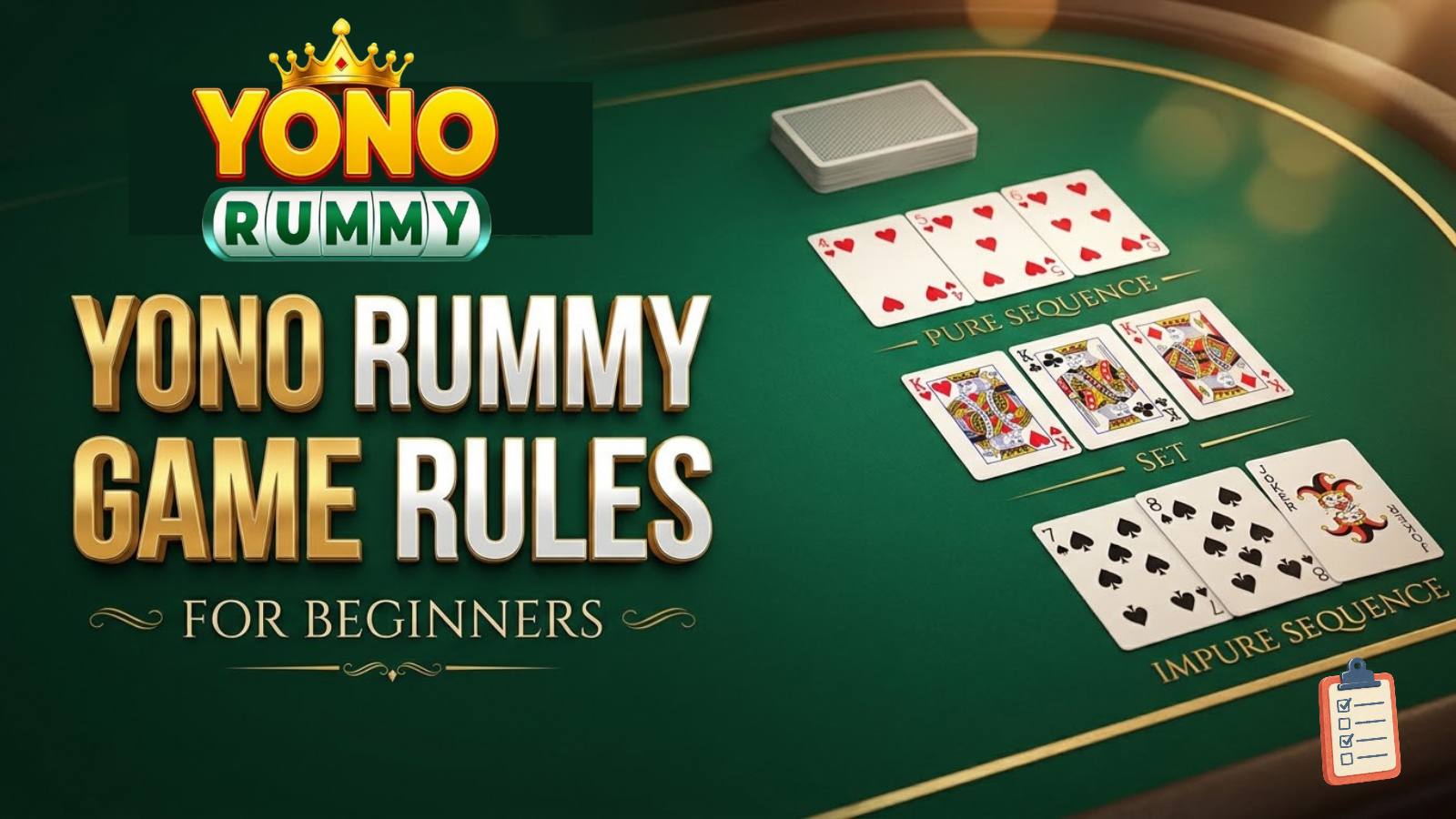
- Sequence: Three or more consecutive cards of the same suit.
- Pure sequence: A sequence formed without using a joker as a substitute.
- Impure sequence: A sequence that includes a joker in place of a missing card.
- Set: Three or four cards of the same rank from different suits.
- Joker: A card that can substitute for another card in an eligible combination under the applicable rules.
- Declaration: A player’s claim that their cards form a valid hand.
Understanding these terms will help you follow the game more confidently.
Yono Rummy Rules: How the Game Works
The following rules explain the standard 13-card Indian rummy format. Always check the rules displayed in your selected game before playing, as other rummy variants may use different requirements.
1. Each Player Receives 13 Cards
At the beginning of a standard 13-card rummy game, each player receives 13 cards.
The remaining cards form the draw pile, and a discard pile is also maintained. Players take turns drawing a card and discarding one card, following the game’s instructions.
The goal is to organise the cards into valid combinations while meeting the declaration requirements.
2. Form Valid Sequences
A sequence consists of at least three consecutive cards from the same suit.
For example:
- 4♥, 5♥, 6♥
- 8♠, 9♠, 10♠
- J♦, Q♦, K♦
Each example is a sequence because the cards are consecutive and belong to the same suit.
A pure sequence does not use a joker as a substitute. In standard Indian rummy, at least one pure sequence is compulsory for a valid declaration.
3. Understand Pure and Impure Sequences
Knowing the difference between these two combinations is important for beginners.
Pure sequence example:
3♣, 4♣, 5♣
All three cards are consecutive and belong to the same suit, with no substitute joker.
Impure sequence example:
7♠, 8♠, Joker
If the joker represents 9♠ and the game permits this combination, the cards form an impure sequence.
A pure sequence is one of the most important combinations to complete early because a joker cannot replace a card in it.
4. Create Valid Sets
A set contains three or four cards of the same rank from different suits.
For example:
- 7♠, 7♥, 7♦
- K♣, K♦, K♥, K♠
The first example is a three-card set, while the second is a four-card set.
Depending on the applicable rules, jokers may be used to complete a set. The same card should not be counted in two separate combinations in a declaration.
5. Use Jokers Carefully
Jokers can help complete combinations when a required card is missing.
In standard Indian rummy, a printed joker or a designated wild joker can generally substitute for a missing card in an eligible combination. However, a joker cannot be used as a substitute in a pure sequence.
For example, if you hold 5♦ and 6♦ but do not have 7♦, an eligible joker may complete the sequence.
Avoid discarding a useful joker without considering how it could help complete your remaining combinations.
6. Draw and Discard Cards in Each Turn
Players generally follow a draw-and-discard process during their turns.
The basic process is:
- Draw a card from an available pile according to the game’s rules.
- Review whether the new card improves your combinations.
- Keep cards that help form valid sequences or sets.
- Discard one unwanted card to finish your turn.
For example, if you already hold 9♥ and 10♥, drawing 8♥ may help complete a sequence. If a card does not support your combinations, it may be a candidate for discarding.
Think about your existing cards before making a decision. The right move depends on your hand and the cards available to you.
How to Play Yono Rummy Step by Step
If you are wondering how to play Yono Rummy, start by learning the card combinations and then follow the game’s turn-by-turn instructions.
Step 1: Understand the Selected Game Format
Open the relevant rummy game and read the displayed rules before joining a table. Check the number of cards dealt, the declaration requirements and the scoring method.
Different formats, such as points, pool or deals rummy, may use different scoring and end-of-game rules.
Step 2: Review Your Initial Hand
Once the cards are dealt, sort them by suit and rank. Look for cards that can form sequences or sets.
For example, if your hand contains 2♣, 3♣, 4♣ and 9♦, 9♥, 9♠, you have a potential sequence and a set.
Do not assume that two combinations are enough to declare. You must organise all 13 cards according to the selected format’s requirements.
Step 3: Prioritise a Pure Sequence
Look for consecutive cards of the same suit that can form a pure sequence.
Completing this combination early can help you plan the rest of your hand. If you do not yet have one, consider which cards could help you form it without relying on a joker.
Step 4: Build Your Remaining Combinations
After identifying a possible pure sequence, work on completing other sequences and sets.
For instance, if you have 5♠, 6♠ and 8♠, the missing 7♠ could complete a sequence. You can also consider whether the cards could form another valid combination under the game’s rules.
Avoid keeping unrelated cards for too long when they are not helping your hand.
Step 5: Draw, Evaluate and Discard
During each turn, check whether the drawn card improves your combinations. Keep useful cards and discard cards that are less likely to help.
Remember that discarding a card may also make it available to another player. Your decisions should be based on your own hand and the visible game information.
Step 6: Check Your Hand Before Declaring
When you believe your cards are ready, verify every combination.
For a standard 13-card Indian rummy declaration, you generally need at least two sequences, including at least one pure sequence. The remaining cards must form valid sequences or sets.
Follow the game’s declaration procedure and ensure that your hand meets all the displayed requirements. An invalid declaration may result in a penalty under the applicable rules.
Example of a Valid 13-Card Rummy Hand
The following example illustrates how a standard Indian rummy hand can be organised into valid combinations.
| Combination | Cards | Type |
|---|---|---|
| 1 | 3♥, 4♥, 5♥ | Pure sequence |
| 2 | 8♣, 9♣, 10♣ | Pure sequence |
| 3 | 6♦, 6♠, 6♥ | Set |
| 4 | J♠, Q♠, Joker | Impure sequence |
| 5 | K♦ | Single card |
Important: This is an example of a 13-card hand, not a completed valid declaration. The final K♦ remains ungrouped, so the player must use it in a valid combination before declaring.
This example shows why beginners should check every card rather than focusing only on the number of completed sequences.
Common Mistakes Beginners Should Avoid
Learning what not to do can help you understand the game more quickly.
Forgetting the Pure Sequence Requirement
In standard Indian rummy, a pure sequence is compulsory. Do not rely entirely on jokers to complete your combinations.
Keeping Too Many Unrelated Cards
Holding cards that do not support a sequence or set can make it harder to organise your hand. Review your cards regularly and discard unhelpful ones when appropriate.
Misunderstanding Jokers
Jokers are useful, but they cannot replace a card in a pure sequence. Check how jokers work in the specific variant you are playing.
Declaring Without Checking All 13 Cards
A hand may contain several valid combinations and still fail to meet the declaration requirements if one or more cards remain ungrouped. Review the complete hand before declaring.
Ignoring the Scoring Rules
Points rummy, pool rummy and deals rummy can differ in how scores are calculated and how a game ends. Learn the rules of the chosen format before starting.
Beginner Tips for the Yono Rummy Game
A few basic habits can make learning rummy more manageable:
- Learn the combinations first: Practise identifying pure sequences, impure sequences and sets.
- Organise your cards: Group cards by suit and rank so that possible combinations are easier to spot.
- Plan before discarding: Consider whether a card can help complete a sequence or set.
- Understand the format: Check the scoring, declaration and penalty rules before joining a game.
- Avoid rushing: Take time to review your hand during each turn.
- Set limits: If you play for money, decide on a spending limit beforehand and stop when you reach it. Never treat rummy as a reliable way to earn income.
These tips can help beginners understand the game, but they do not guarantee a win.
Frequently Asked Questions
1. What are the basic Yono Rummy game rules?
In standard 13-card Indian rummy, each player receives 13 cards and tries to arrange them into valid sequences and sets. A valid declaration generally requires at least two sequences, including one pure sequence.
2. How do I play Yono Rummy for the first time?
Start by reading the rules of the selected game format. Sort your cards, look for a pure sequence, complete the remaining combinations and draw and discard cards during your turns. Check the entire hand before declaring.
3. How many sequences are required in Indian rummy?
A standard 13-card Indian rummy declaration generally requires at least two sequences, of which at least one must be pure. The remaining cards must also be arranged into valid combinations.
4. Can I use a joker to make a pure sequence?
No. A pure sequence cannot use a joker as a substitute for a missing card. Jokers may be used in eligible impure sequences or sets according to the applicable rules.
5. What happens if I make an invalid declaration?
An invalid declaration may result in a penalty or loss under the selected game’s scoring rules. Check the rules shown in the game for the exact consequences.
6. Is the Yono Rummy game suitable for beginners?
Beginners can learn the basic rules of rummy by practising card combinations and understanding the selected format. If the game involves real money, users should also understand the financial risks and applicable eligibility requirements before participating.
7. Are the rules the same in every Yono Rummy format?
Not necessarily. Different rummy variants may have different scoring systems, entry conditions and end-of-game rules. Read the rules displayed for the particular game before playing.
Final Thoughts
Understanding the Yono Rummy game rules starts with learning how sequences, sets and jokers work. For standard 13-card Indian rummy, beginners should focus on forming a pure sequence, arranging the remaining cards into valid combinations and checking every card before making a declaration.
Once these basics are clear, the next step is to understand the specific format’s scoring and declaration rules. Read the displayed instructions carefully, play responsibly and remember that even a well-organised hand does not guarantee a win.
Responsible gaming note: Real-money gaming involves financial risk. Participation should be limited to eligible adults where permitted by applicable law. Check current local restrictions and the platform’s terms before playing.